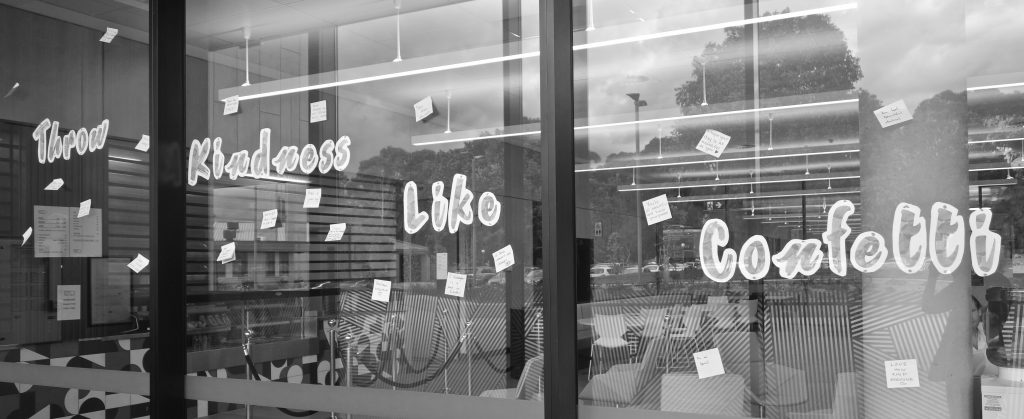
I stumbled on a reading challenge by my local ACT library this week, and at first I dismissed it as I do with challenges generally. But the list of categories looked manageable for what remains of 2019 and the thought occurred to me that I could tick them off, no worries. It came to me a few days after I found a new library in the small Australian Catholic University around the corner from me that has a very welcoming wall at the entrance. Here it is. Zoom in (click and click again) to read students’ stick-it notes…
Here I picked up a book I’d always avoided for no good reason, The Magic Pudding by Norman Lindsay, an early Australian classic, which fits one of the categories of the challenge, ‘Something you regret not having read yet’.
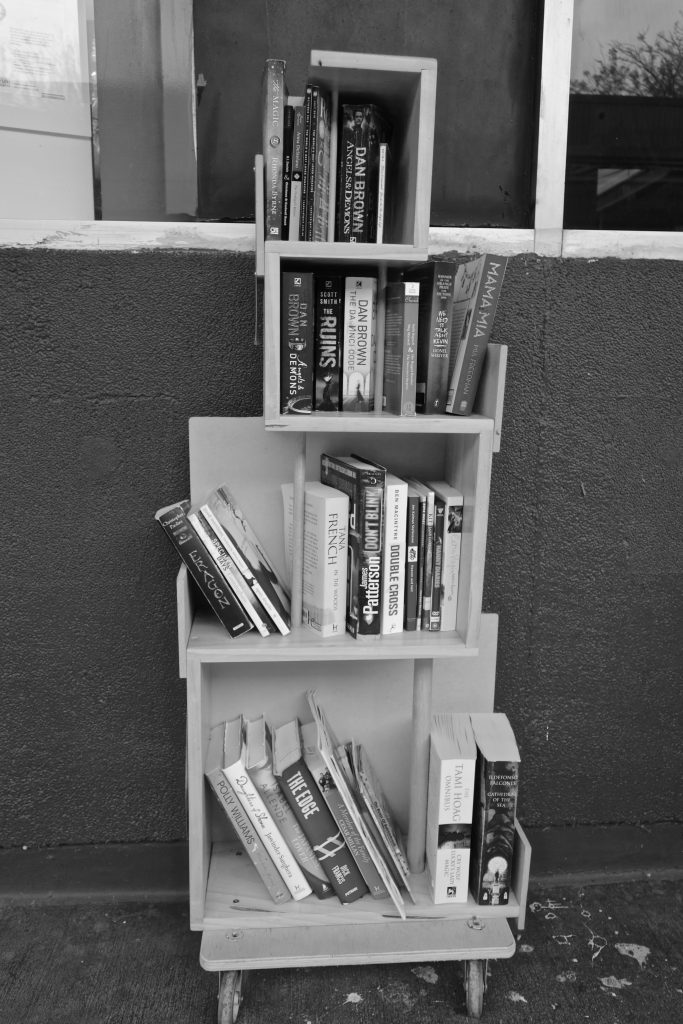
And then this morning, I cast my eye quickly over the pop-up library outside a local café. Zoom in to see what sort of books Canberrans read…
There on the shelf was a book that someone once highly recommended, The Kite Runner by Khaled Hosseini. I’ve brought it home, except now I remember having read it, but it fits another challenge category, ‘Something you want to re-read’.
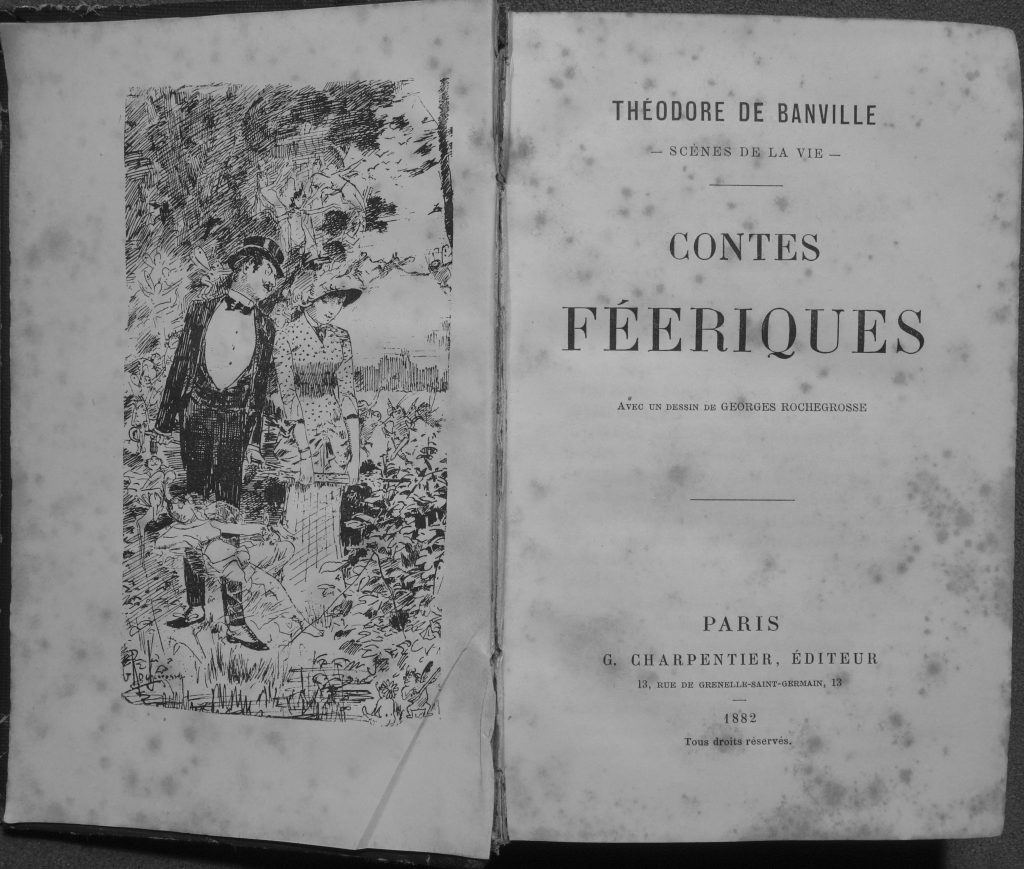
That’s two. But I have a third book that fits the category ‘Set in an imaginary world’: Contes féeriques (Faeric Tales) by Théodore de Banville. The title page is illustrated by Georges Rochegrosse, his stepson. Note the age spots, it’s an old one. Zoom in to see the fairies floating around the amorous couple…
Banville wittily gives it the subtitle ‘Scenes from Life’, but every tale revolves around the intervention of a fairy, magician or other supernatural figure! I recently had a translated story published that comes from this collection, ‘The Lydian’ which you can read for free if you click the link, and if you click here you can read more about it. But I haven’t yet read every story in the book, so it’s going on my challenge list.
That’s three, and only seventeen more to find to tick off everything on the challenge list. It should take my reading to the end of this year:
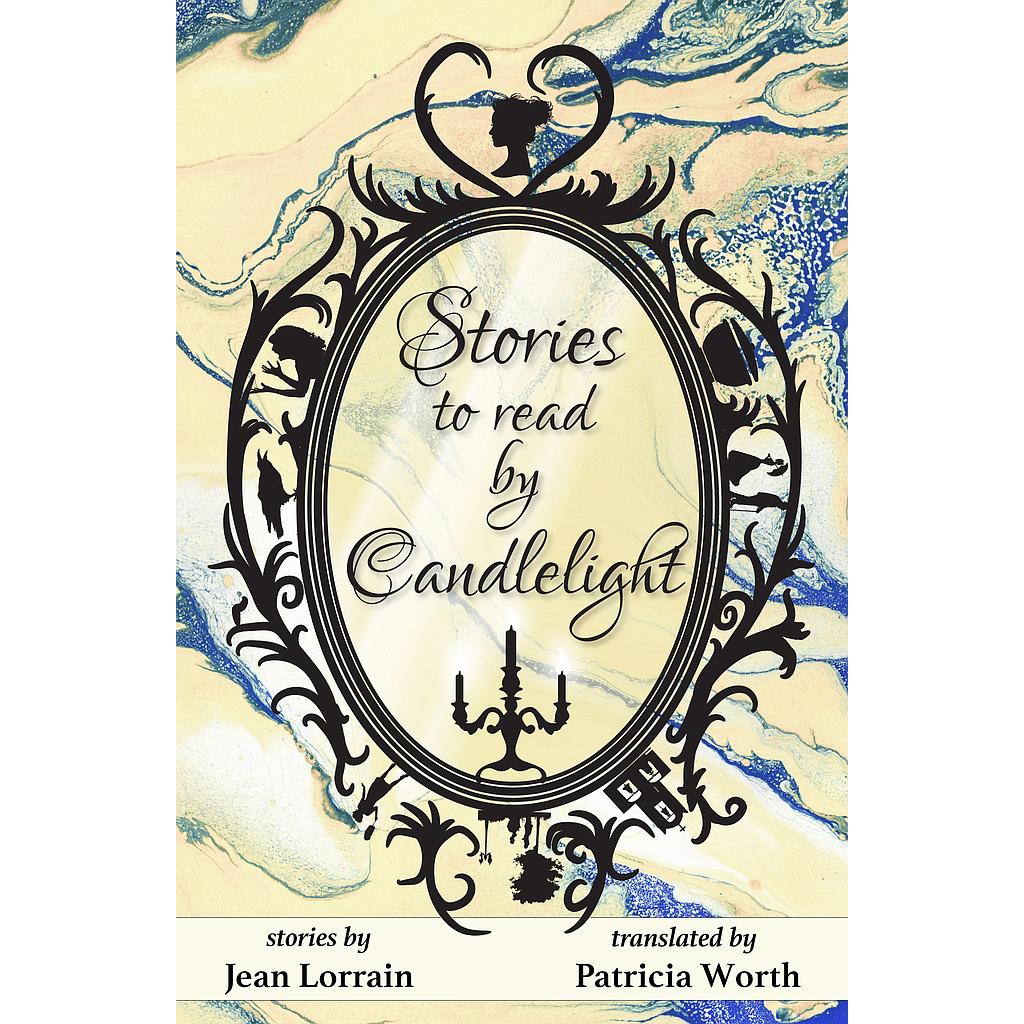
I was searching the internet this week for any mention of a translated book I’m waiting for. It’s my own translation, not yet published. The publisher, Michelle Lovi at Odyssey Books, has been working on it, so I wondered if she’d mentioned it somewhere online. Hooray! My search produced a result: I found a cover on Booktopia, and a chance to pre-order the whole book. The link is here.
Here’s a preview of the cover:
The stories are from Jean Lorrain’s small collection, Contes pour lire à la chandelle, first published in 1897 though most of them had appeared in illustrated journals in the previous ten years. A few of these 19th-century illustrations can be seen in my blog posts here, here and here.
The new book will also be illustrated. The silhouette images on the cover give a clue to what will be inside, but they’re not yet ready. You can imagine how eager I am to see how they look!
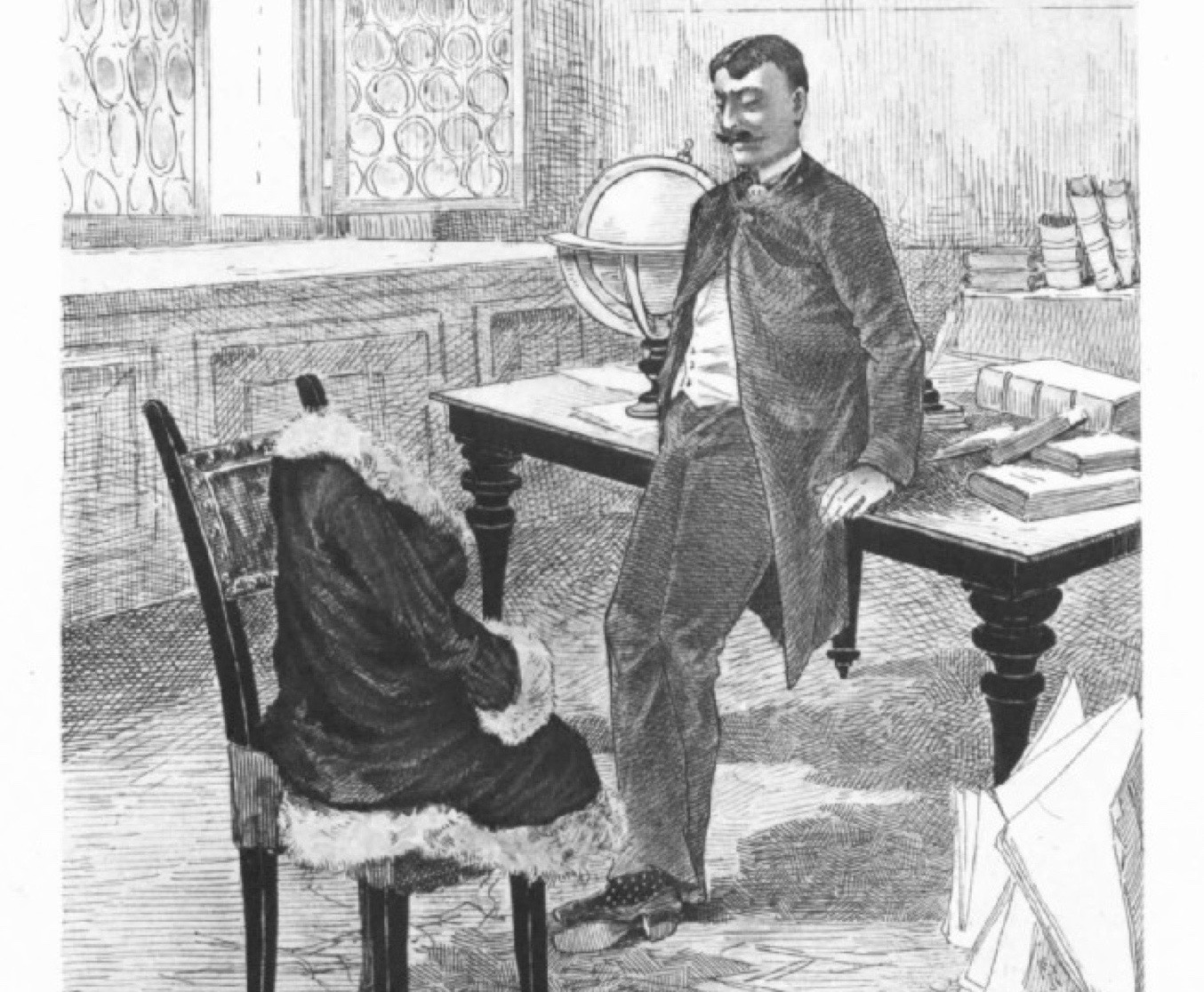
Back in 2016 I had a translated story published by The Cossack Review. I’ve just learnt that this journal exists no more, it has gone the way of a good percentage of literary journals. The story is ‘Joseph Olenin’s Coat’ by Eugène-Melchior de Vogüé, a quirky tale about a lonely man in an isolated wintry part of Ukraine, who loses a coat, finds one, and falls in love with it.
‘Le Manteau de Joseph Olénine’ in ‘Les Lettres et les arts’, 1st July 1886, first page, illustration by M. Saint-Elme Gautier
It was originally published in 1886 in an illustrated journal, ‘Les Lettres et les arts’. Who wouldn’t want to read a story with a decorative border round the opening paragraph such as this one by Saint-Elme Gautier? (Click the image to see the detail.) There were several illustrations throughout the story but the best one is ‘Contemplation’ by M.H. Gray showing the poor man gazing at the woman’s coat he’d accidentally acquired and wondering what its owner looked like, felt like…
‘Contemplation’ by M.H. Gray
My translation was published in a print journal and, fortunately, I have a copy of it. It was also available online for a time, but has now disappeared. The editor, Christine Gosnay, had asked me some questions for an interview, and those questions and answers are still there, albeit in a basic format without the styling of the original web site. It would be a good idea, I think, to re-post the interview here.
Patricia Worth: Contributor Interview
May 28, 2016
TCR: What are you reading now?
Patricia Worth: Tales of Hans Christian Andersen translated by Naomi Lewis. And All the Light We Cannot See by Anthony Doerr.
TCR: How and where did you find out about de Vogüé’s work?
Patricia Worth: A library at the Australian National University has a collection of old French literature that hasn’t been borrowed for decades. Here I found a small dusty book of short stories by Eugène-Melchior de Vogüé (whom I’d never heard of), and chose it simply for the title ‘Nouvelles orientales’, a title invented by a publisher. Expecting Orientalism and hot Middle Eastern settings, I found instead stories set mostly in wintry Russia and Ukraine. They are nonetheless fascinating. Several had originally been published in de Vogüé’s collection, ‘Les Coeurs russes’ (Russian Hearts), and a few were translated in 1895 as ‘Russian Portraits’, a translation which did not include “Joseph Olenin’s Coat’.
TCR: Do you plan to translate any of his other stories?
Patricia Worth: I have translated all the stories in ‘Nouvelles orientales’.
TCR: How long did it take you to translate “Joseph Olenin’s Coat’?
Patricia Worth: As I translated the whole book of ten stories, it’s hard to say how long it took me for each one. But, in general, a rough translation of a short story takes me a few days, and then I polish it for a few months, researching details, asking experts for help and getting people to read it and comment.
TCR: Can you describe your process for taking somewhat antiquated work from one language to another, especially with respect to diction and tone?
Patricia Worth: De Vogüé was strongly influenced by Russian authors like Turgenev, and as a literary translator I have long admired Constance Garnett’s translations of Turgenev’s short stories, so I looked to her example when working on de Vogüé’s stories. For Garnett, less is more. She generally writes with fewer syllables and fewer words than other translators. In Turgenev’s “The Tryst’, for example, Garnett writes “the hue of an over-ripe grape’, where a modern translator writes “which resembles the colour of overripe grapes’; or “Not one bird could be heard’, against “There was not a single bird to be heard’. When I consider the readability of my work, hers is the brevity I come back to.
It’s also good to read modern English authors who have created a sense of another time, like Joan Lindsay and her ‘Picnic at Hanging Rock’, published in 1967 but set in 1900, or J. L. Carr, ‘A Month in the Country’, published in 1980 but set in the years after the Great War. These two have also taught me much about making every word count.
Of great help, too, are readers of my drafts who are familiar with older texts. For “Joseph Olenin’s Coat’ a French friend pointed out the subtle words that alert a native speaker to the spirit in the coat that enters Joseph’s life and obsesses him against his will, and to the superior tone used by the Countess when addressing Joseph. A local writer and translator of Proust who reads most of my work also offered corrections and suggestions to take my diction back in time (for example skating, not ice-skating).
When I find myself stuck in today’s English, help is available by entering a French phrase into a search engine which can trigger old pieces where the words are used in other contexts. The search might even produce helpful French translations of English classics by, say, Dickens or H.G. Wells, and then I look for the phrase in the original, and use a variation of it. There are also a number of French and French-English dictionaries from the 1700s and 1800s freely available online; these are invaluable for learning the former meaning of a word. Of course, I read, read, read nineteenth-century English literature, the Brontë sisters and Thomas Hardy among many others.
TCR: Who has had the biggest influence on you as a writer?
Patricia Worth: For translation, I’ve been influenced by the various translators of Hugo’s Les Misérables as well as Constance Garnett’s translations of Russian literature. For writing in general, I find Charlotte and Anne Brontë’s novels compelling, and hold them as my standard. I was also influenced by my father, a volunteer soldier, who wrote poetry in Egypt in 1941.
TCR: What authors do you re-read?
Patricia Worth: The Brontës.
TCR: What is your next writing project?
Patricia Worth: I’m presently translating a book of French fairy tales.
***
PS: I’m surprised to read that I was translating the fairy tales when I responded to this interview. Those fairy tales, Stories to Read by Candlelight, are presently on the production line and should be appearing some time before June this year. I’d forgotten how long I’d been working on them.
I recently had a bathroom renovated and had to remove this sign which had been stuck to its wall for years. (I don’t live near the sea.)
I haven’t put it on the new wall, so now it sits abandoned in a bedroom where I read it every time I walk past. I’ve never stopped believing what it says.
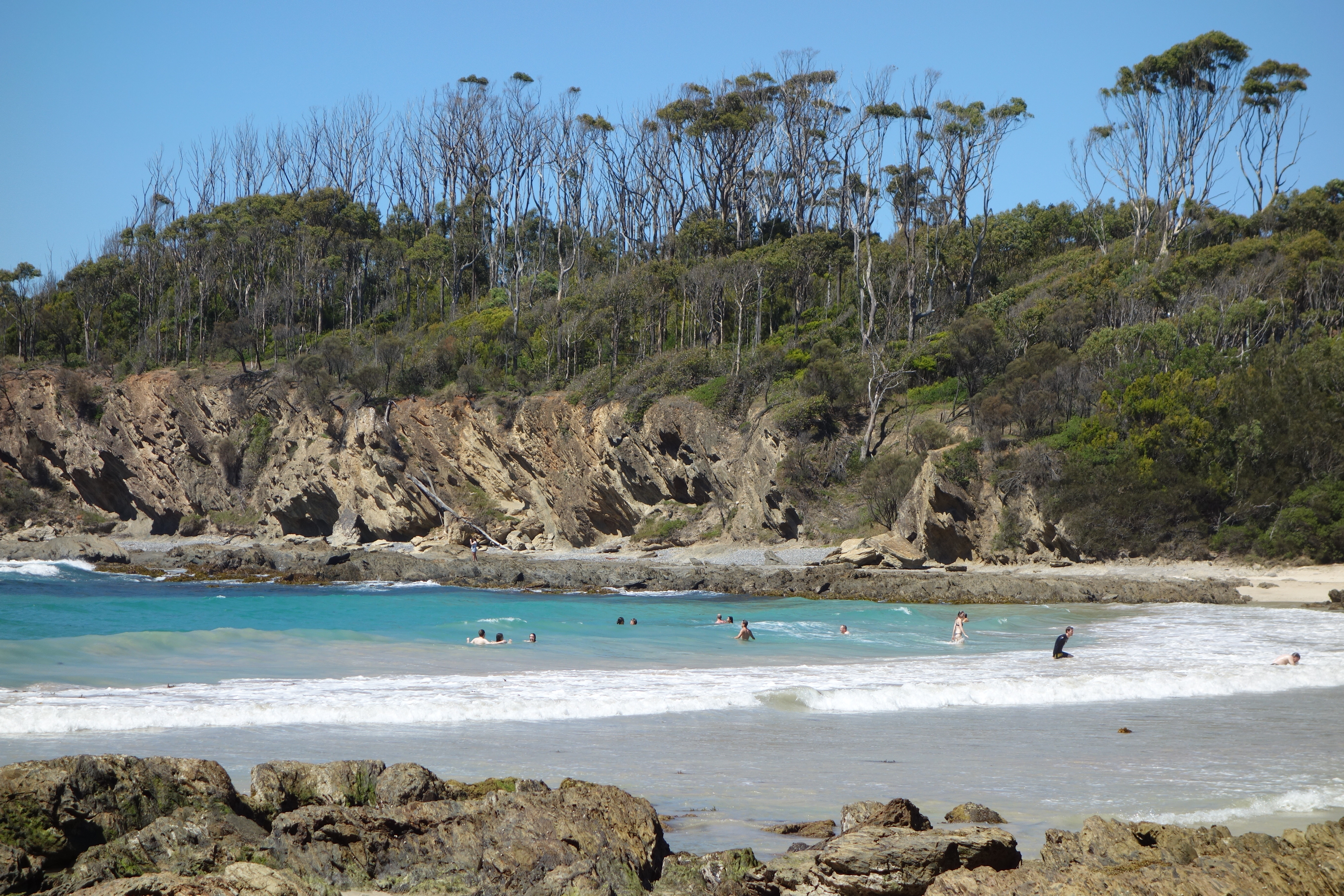
In recent months I’ve spent time on the beautiful beaches of New South Wales, and just this last weekend as I walked the length of Lilli Pilli beach, I thought of my sign and realised that it was true, all my pitiful thoughts were washing out with the waves.
There were rewards even for resting my eyes on the water in this shallow bay of Lilli Pilli Beach where the sea near the shore is turquoise.
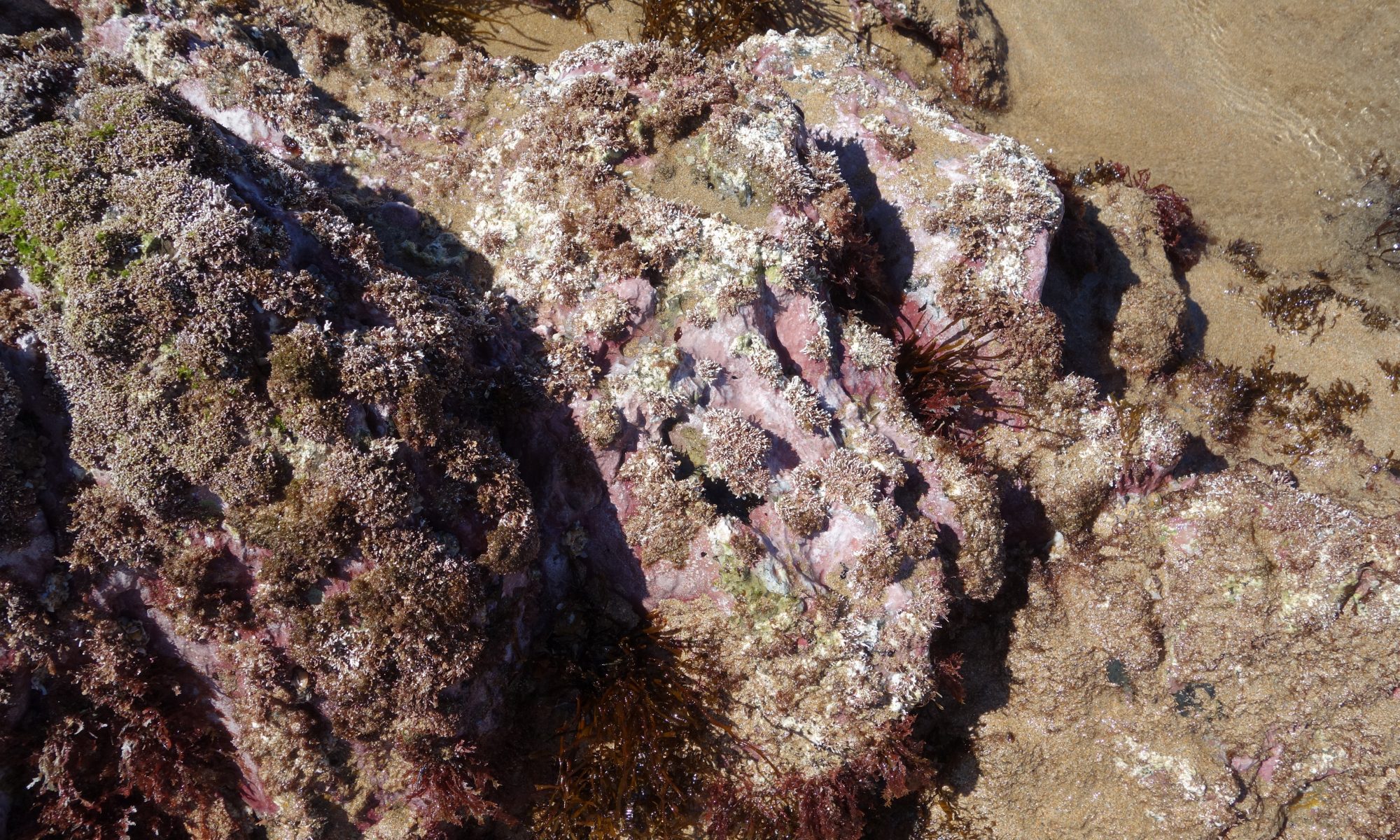
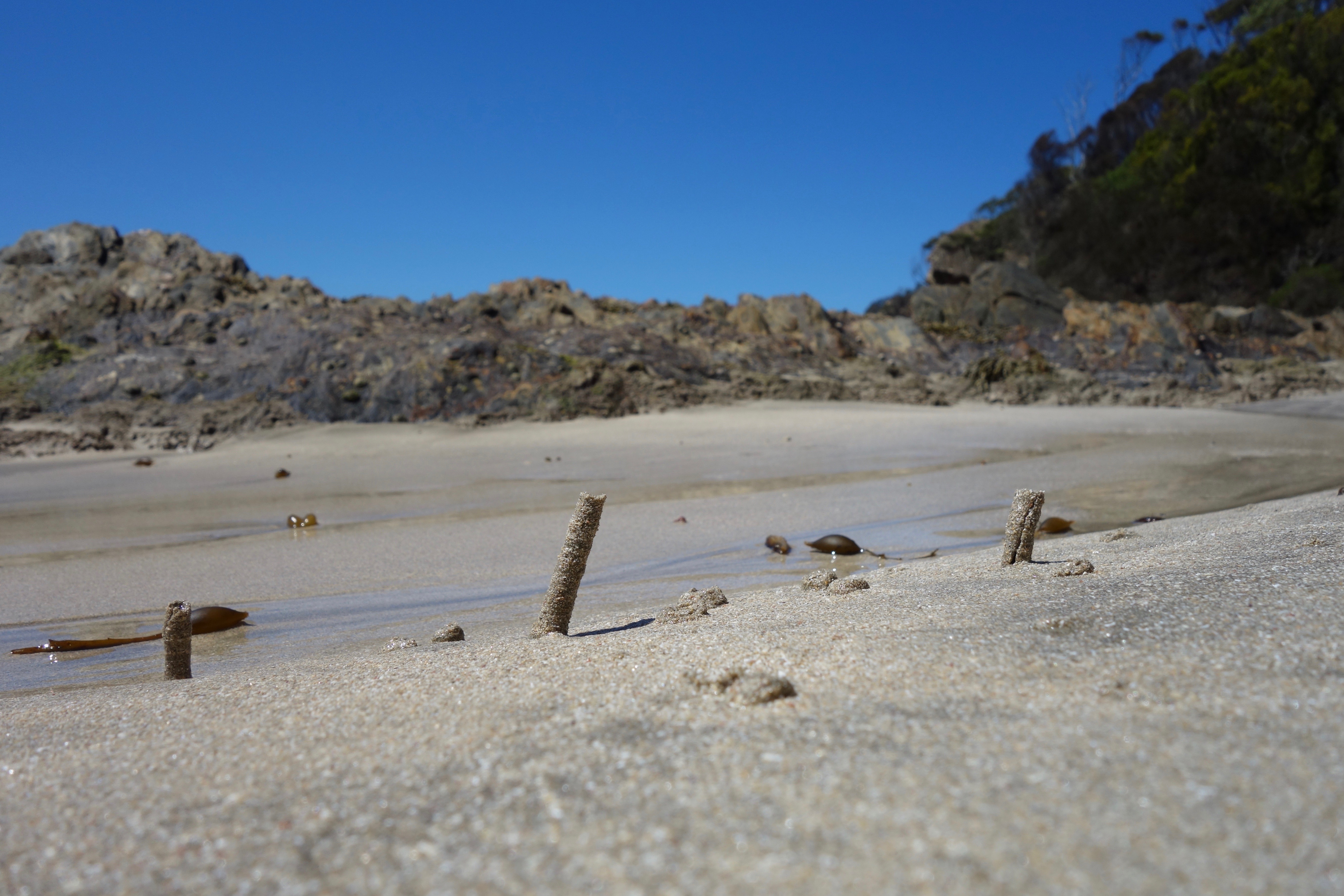
By the sea, natural beauty fills my head and heart to the brim. There’s no room for anything negative, only praise. Just look at these three tubes protruding from the sand. I know little about them but a search leads me to believe they were built by worms. Amazing, fragile structures.
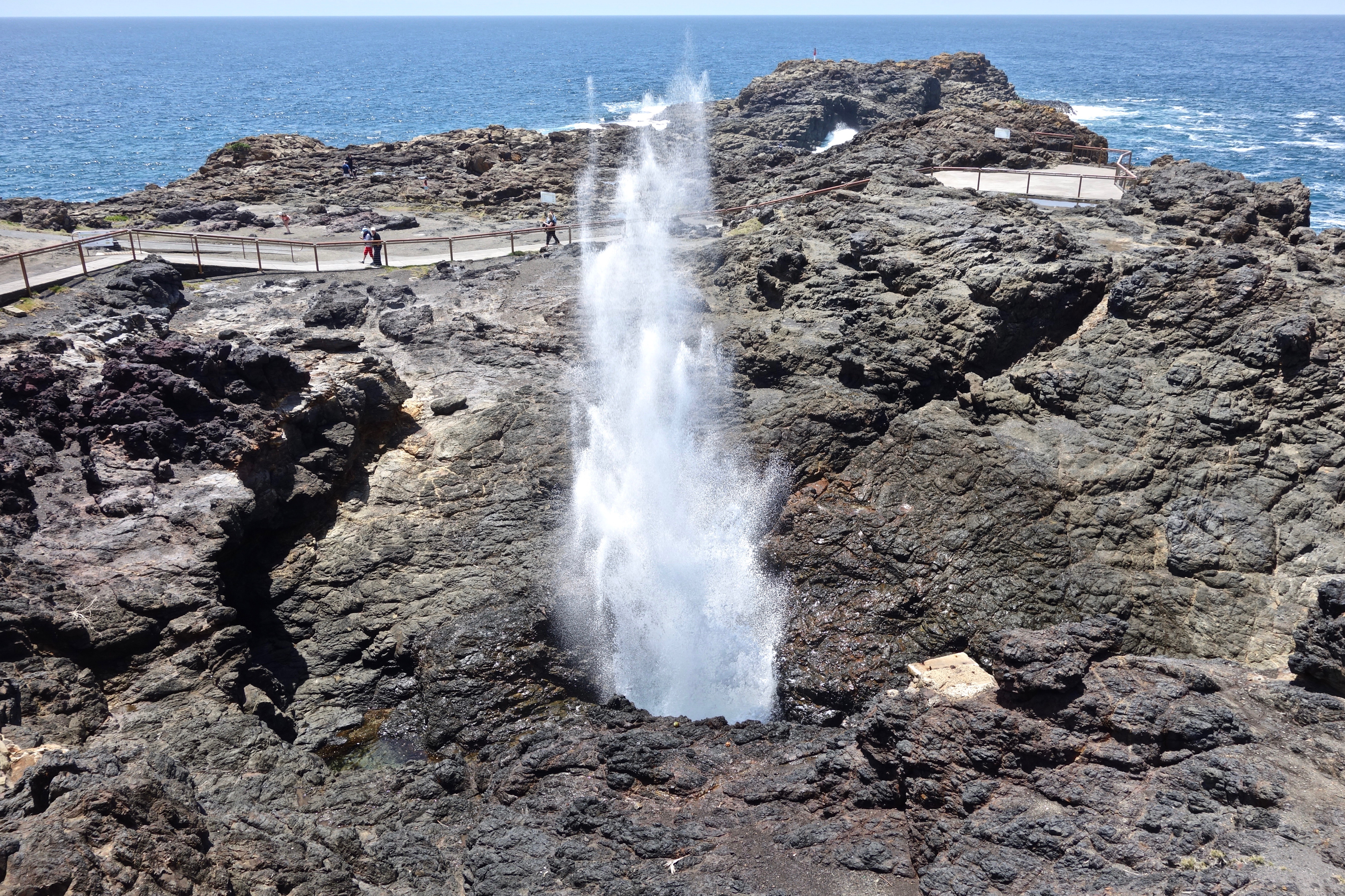
Further up the coast is Kiama and the Devil’s Blowhole, a gap in the cliff rocks where waves come rushing into a cave below and shoot up through the hole like a fountain. The spout has taken a few lives over the centuries, but today a fence ensures that as long as I stay behind it, my worries will be washed away but I won’t!
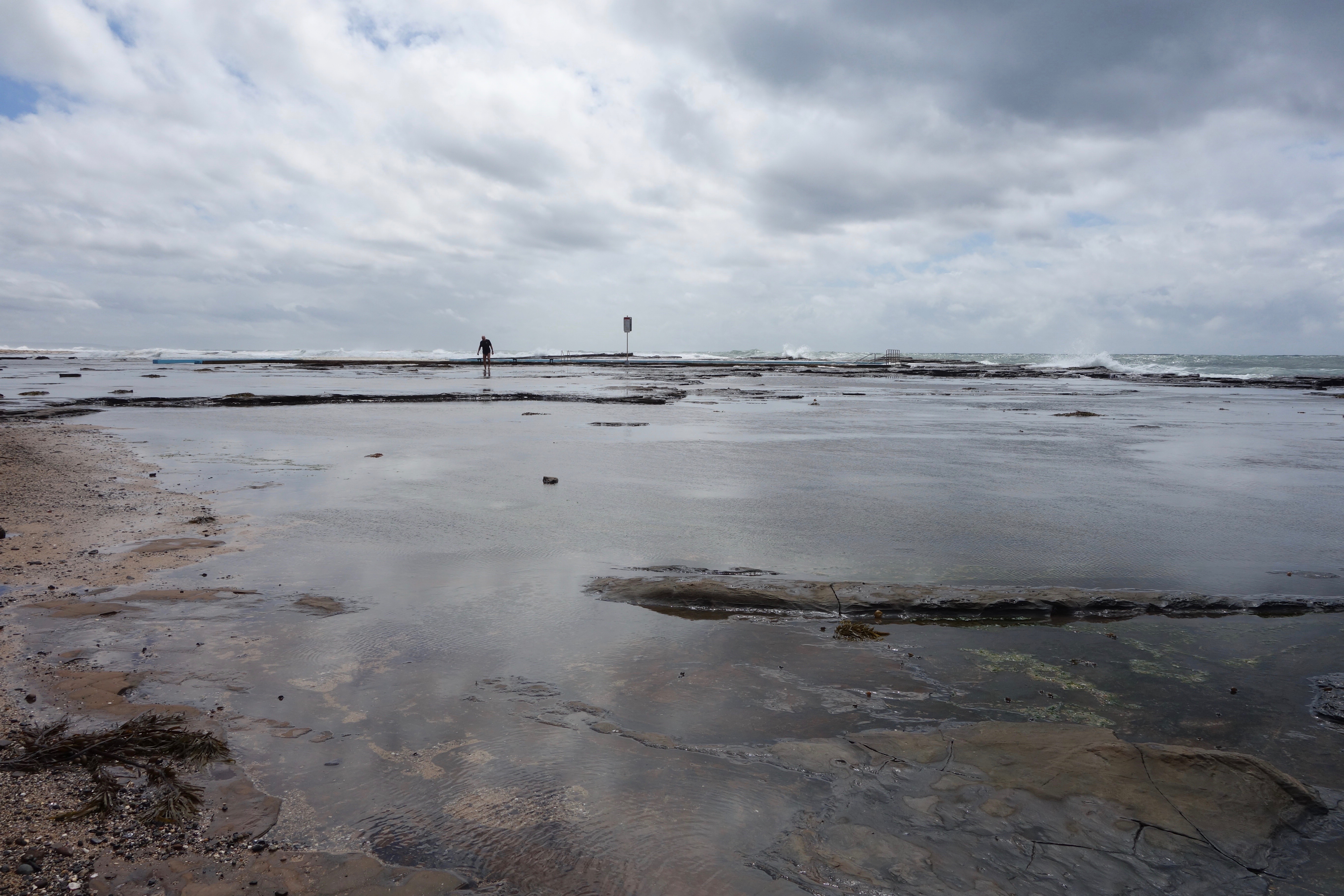
Even when the sea is not turquoise or even blue, it can still have a unique beauty. This steel grey rock pool at Coledale in Woollongong, the biggest rock pool I’ve ever seen, reflects the expanse of grey clouds in its smooth grey surface and takes my breath away. One old man was swimming in the sea baths while I was there. It wasn’t a warm day. But he had the whole baths, this whole part of the ocean, to himself.
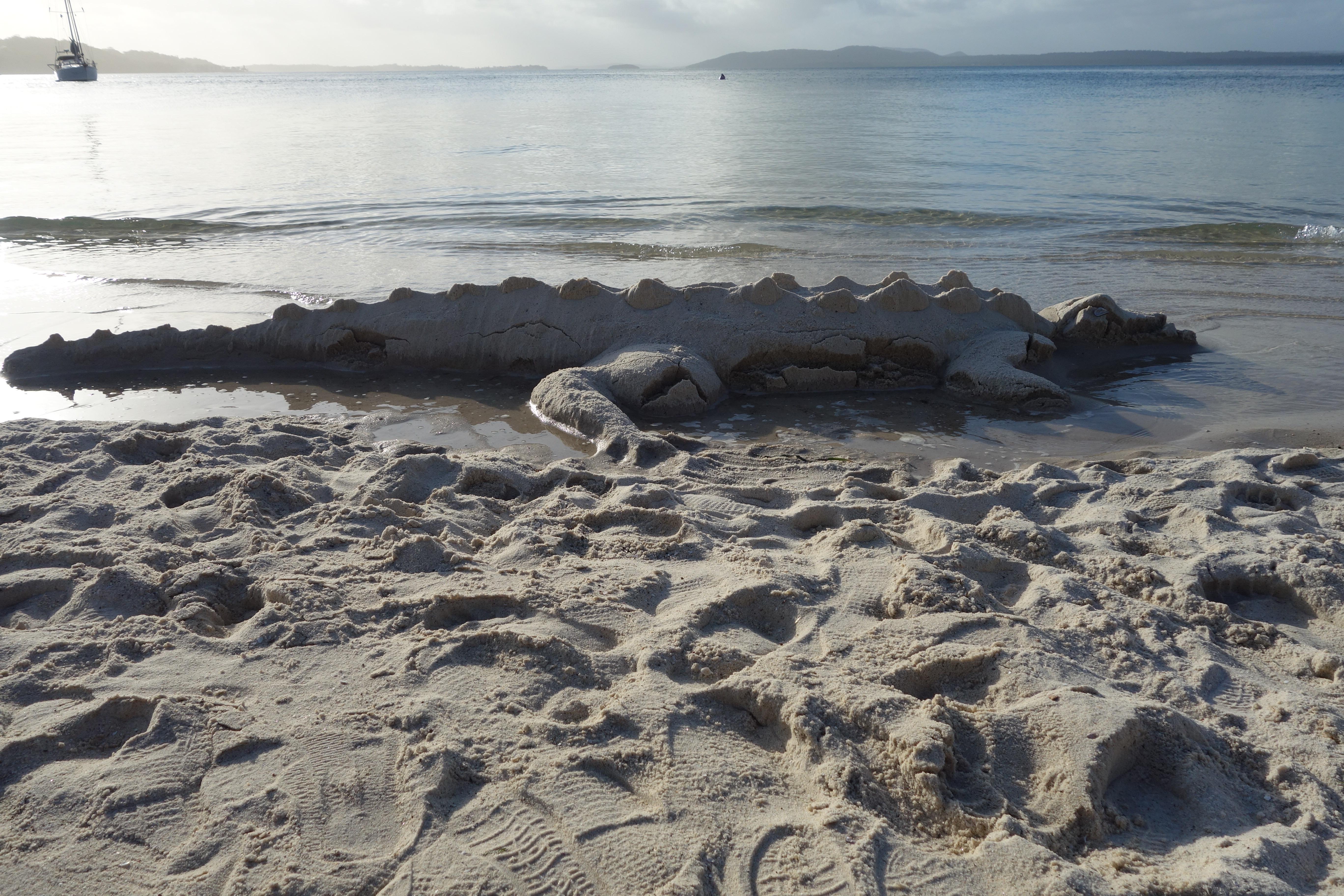
While we all leave our footprints on the beach – the loneliest stroller is aware of all those who strolled before her – sometimes humans can leave behind something admirable. Like wandering minstrels, wandering artists can enhance nature, and out of the kindness of their hearts make a sand sculpture, a piece of public art, temporal as it will be. I passed this crocodile at the water’s edge in Port Stephens late one afternoon and felt very lucky to catch it before the incoming tide broke it up completely.
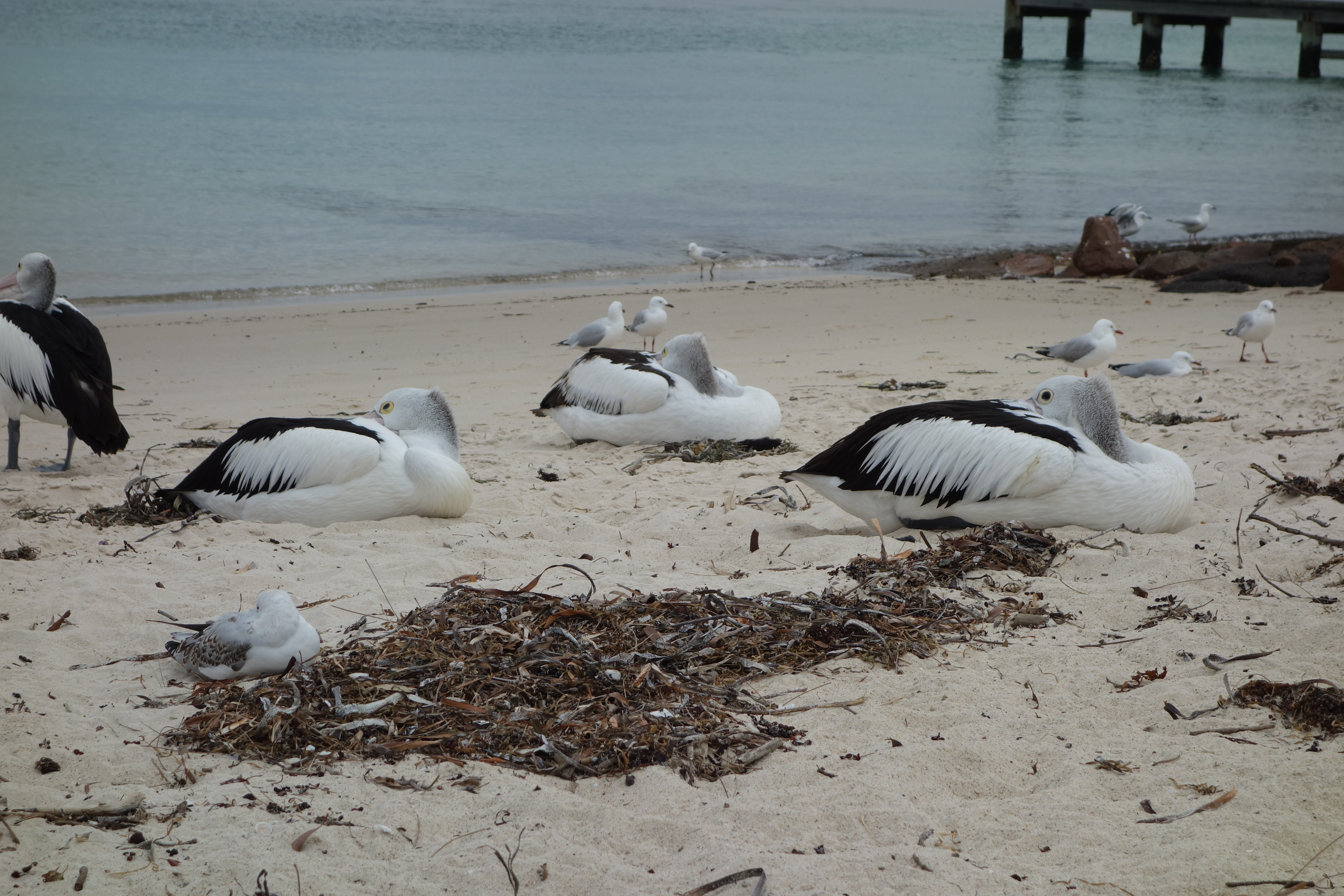
But the best moments are when I see real creatures on the beach. On a shore near the old Nelson Bay lighthouse (now the Inner Light Tea Rooms!) these pelicans and seagulls made my day with their sleepy poses and big doll eyes.
Back in the city, far from the sea, all I have left is my sign to remind me that worry is inevitable but relief can be had if I can get to a beach. (The nearest one is just two hours’ drive away…)